World building
Learn more about the development of the Planet Nine Trilogy, its characters, and the real science behind the books.

How it Began
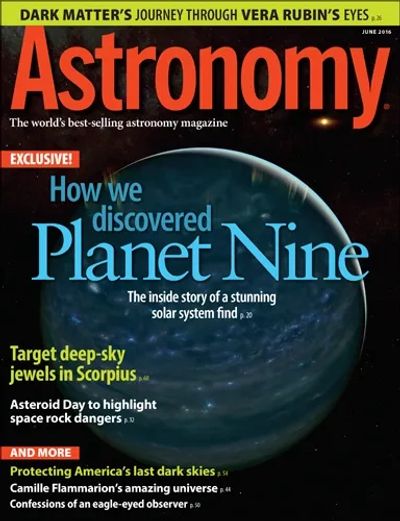
In the spring of 2016, I came across an issue of Astronomy Magazine with a very intriguing cover article: “How we discovered Planet Nine.” The article described a theory that was developed to explain the odd orbits of several trans-Neptunian objects (TNO’s) in the outer solar system, dwarf planets and asteroids outside the orbit of Neptune. The theory proposed that another large planet might be lurking there, in a region so far from the sun that it had been overlooked. For me, this idea seemed like the perfect setting for a space adventure story set in a future when human beings develop the space travel technology to finally explore this mysterious Planet Nine. It would be almost a year, though, before I began drafting the plot and characters for The Settlers of Planet Nine.
Image credit: Astronomy Magazine, https://www.astronomy.com/issues/2016/june-2016/
Legendary creatures
Early on, I decided that my fictional Planet Nine would be a planet on which creatures familiar from Earth’s various mythologies would actually exist. Possibly, in the story, these mythical monsters preserved the memory of a time when the creatures of Planet Nine came to visit us. Some of the first sketches featured a wise, Gnome-like creature and some scenes that I intended for my human characters to find carved on an ancient and mysterious Stone.
Here are some of the important alien species that appear in the Planet Nine Trilogy:
Cortam (plural: Cortax) - Originating on Planet Nine, the Cortax are a tribal species of three-legged beings with bowl-shaped heads. They have a stone-age culture and are always traveling across the land regions of Planet Nine.
Glarcus (plural: Glarkoii) -The Glarkoii are a wise and very ancient species that migrated to Planet Nine from another star system after their home sun became unstable. They have three eyes, crab claws, and walk on sixteen short tentacles. Glarkoii are easily recognized by their characteristic pointed cap, which varies in color and design based on the individual's status and tribe.
Phifiszl (plural: Phifiszlii) – The Phiffiszl is large, green, and muscular creature that lives on Planet Nine. It is basically humanoid, but has one large eye and two elfish ears. Phiffiszlii travel between Planet Nine’s islands using a kind of boat called a saph.


Planet Nine's Ecosystem
When developing The Settlers of Planet Nine, it was important for me to explain how Planet Nine could be capable of supporting life. According to the real-life theory, Planet Nine would be about the same mass as Neptune, a gas planet with no solid surface—not a home for life as we know it. In the trilogy, I imagine Planet Nine as a super-earth planet, a class of planet that has often been observed around other stars but has no representative in our solar system. These planets are more massive than Earth but significantly less massive than Neptune. Since there are no super-earth planets close to Earth, scientists do not know what their surface conditions are like, whether they are rocky, gaseous, or covered in planet-wide oceans.
The fictional Planet Nine has both terrestrial and aqueous environments, much like Earth, although Planet Nine has much more ocean than land. Being more massive that our world, Planet Nine experiences a greater gravitational stress on its rocky crust. As a result, there is a large amount of volcanic activity on Planet Nine, producing an abundance of island chains that rise above the ocean surface. Gas released by these volcanoes contributes to an intense greenhouse effect, trapping thermal energy close to Planet Nine’s surface and keeping the planet warm enough for living organisms to evolve.
Astronomical Facts about the Fictional Planet Nine:
Distance from the sun: 60.78 AU (average; Astronomical Units: 1 AU = 93 million miles or the distance between Earth and the sun)
Rotational period (day): 62.4 hours
Orbital period (year):approximately 1,500 Earth years
Mass: approximately 8x the mass of Earth
Surface temperature: 73 to 323K (-200 to 50 degrees Celsius)
Gravity: 1.2 Earths
Atmospheric Composition: carbon dioxide, oxygen, nitrogen, sulfur dioxide, ammonia
Moons: 7
Astrobiology
Planet Nine is very, very far from the sun, which appears as a small, bright point in this sketch of Planet Nine's environment, which is often dark and cloudy, illuminated only by volcanic lava and the lightning of frequent storms. On Earth, most organisms rely on the energy produced by the sun, either through photosynthesis or by consuming photosynthetic organisms. However, there are a few extreme environments where this is not the case. Near hydrothermal vents at the bottom of deep ocean trenches, where the sun does not shine, organisms have been found that rely on chemosynthesis, feeding directly on the chemicals that spew from the vents. Planet Nine’s food chain could operate in a similar way, relying on a kind of fungus that draws nutrients from the mineral-rich volcanic soil, as pictured here.